


CATL Invests RMB 130 Million in LFP Recycling Project at Its Liyang Manufacturing Base
CATL is planning a new lithium-ion battery recycling project at its manufacturing base in Liyang, Jiangsu Province.
According to the environmental impact assessment filing, Jiangsu CATL New Energy Technology Co., Ltd. plans to invest RMB 130 million (approximately USD 18 million) in an “end-of-life lithium-ion battery electrode recycling project.”
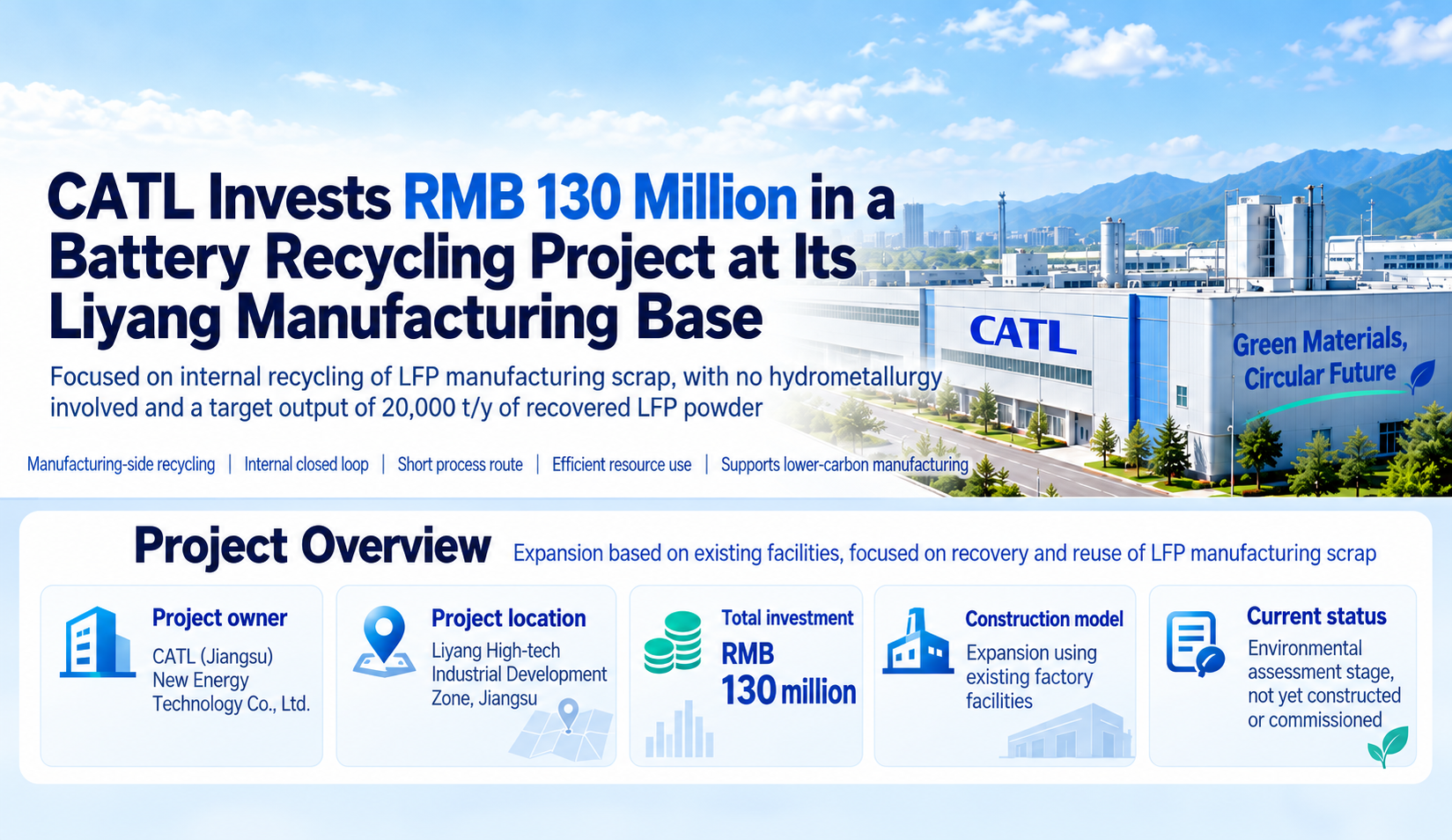
Unlike a conventional recycling facility designed to process batteries collected from the market, this project will be built by upgrading existing facilities at CATL’s cell manufacturing base. Around 32,000 square meters of existing factory space will be used for the new recycling line.
Once completed, the project is designed to produce 20,000 tonnes per year of recycled LFP electrode material.
Around 39,600 tonnes of manufacturing scrap per year
According to the material balance disclosed in the filing, the project is designed to process approximately:
2,600 t/y of unfilled LFP batteries, 21,000 t/y of bare LFP cells, 13,000 t/y of LFP electrode rolls, and 3,000 t/y of scrap LFP electrodes.
Total annual feedstock would therefore reach about 39,600 tonnes, from which the project expects to produce around 20,000 tonnes of LFP powder. Other outputs include anode material, separators, aluminum foil, aluminum casings and process residues.
Importantly, these materials are all pre-electrolyte manufacturing scrap.
The filing states that incoming materials must contain no electrolyte and no charged cells. Feedstock will be sourced only from CATL’s own manufacturing network, and the project will not accept waste from external companies.
This makes the project more accurately described as an internal LFP manufacturing-scrap recycling project, rather than a conventional end-of-life battery recycling plant.
No hydrometallurgy: LFP material is directly recovered
The environmental filing explicitly states that the project does not involve hydrometallurgical processing or pyrometallurgical smelting, and no acid-leaching or solvent-extraction process is included.
Instead, the main process is:Dismantling → shredding → mechanical powder separation → aluminum removal → nitrogen-protected heat treatment → crushing and screening → magnetic separation → quality inspection → LFP powder
During mechanical separation, LFP active material, conductive carbon and PVDF are removed from the aluminum current collector.
The recovered cathode powder is then heat-treated at approximately 300–700°C under a nitrogen atmosphere. The main purpose is to decompose and remove PVDF while preventing oxidation of Fe²⁺ in LiFePO₄. The filing specifically states that LiFePO₄ itself does not participate in the reaction during this stage.
In other words, the process is not designed to break LFP down into lithium, iron and phosphorus.Instead, it aims to retain the value of the existing LFP cathode material and recover it through mechanical separation, thermal treatment and impurity removal.
Direct recycling, but not necessarily direct regeneration
Technically, the project has many characteristics of Direct Recycling. However, it should not yet be described as a typical Direct Regeneration process.
Direct regeneration of aged LFP materials often involves steps such as: relithiation, lithium replenishment, crystal-structure repair, defect healing or carbon-coating reconstruction. None of these steps are disclosed in the environmental filing.
That also makes sense given the feedstock. Most of the materials are manufacturing scrap such as unfilled cells and electrode waste that have never undergone years of electrochemical cycling. They therefore do not suffer from the same lithium loss and structural degradation as end-of-life LFP batteries.
The project is more accurately described as: direct recovery and reuse of LFP cathode material from manufacturing scrap.
Recovered LFP stays within CATL’s manufacturing network
The final product is not black mass or lithium carbonate, but LFP powder.
The filing states that recovered material must meet the requirements of China’s standard for carbon-coated lithium iron phosphate cathode materials, GB/T 30835-2014.
Qualified material will either be used internally by Jiangsu CATL or supplied to other CATL manufacturing bases.
Battery recycling is becoming increasingly integrated into the manufacturing system itself.
The Liyang project is also not CATL’s first attempt at this route. According to the filing, the technology is supported by CATL Group, and similar projects have already been implemented at other CATL sites.
In particular, a materials recycling project operated by CATL’s Sichuan subsidiary completed its environmental acceptance in August 2026. The project handles the same types of LFP manufacturing scrap and uses the same processing route as the planned Liyang facility. This suggests that the Liyang project is not simply an experimental recycling line.
It appears to be part of a manufacturing-scrap recycling model that CATL has already validated and is beginning to replicate across its production network.
For years, much of the battery recycling industry has focused on when large volumes of LFP batteries will reach end of life. But manufacturing scrap will arrive much earlier.
Unfilled cells and electrode scrap have several advantages: their chemistry is known, their origin is traceable, and they have not undergone long-term electrochemical degradation.
That makes them particularly suitable for shorter-loop recycling routes that seek to preserve the value of the cathode material itself.
CATL’s Liyang project therefore signals a broader shift:
battery circularity is increasingly moving from the end-of-life stage toward the manufacturing stage.
End-of-life batteries will continue to require specialized collection and large-scale recycling networks. But high-quality manufacturing scrap may increasingly remain inside battery manufacturers’ own closed-loop systems.
For the LFP recycling industry, the first major competition for feedstock may therefore not begin with batteries retiring years from now.
It may already be starting with the manufacturing scrap being generated inside gigafactories today.
